This glossary serves to understand some of the basic concepts of the use of ANSYS software for the study of heat transfer in different media, in this case we will focus on the analysis of heat sinks and we will analyze some of the concepts necessary to perform an analysis. of this type, such as the boundary conditions, the meshing, and the necessary properties.
ANSYS Workbench
Noun.
It is a software platform from which CAE analysis projects are created in different disciplines, Workbench graphically displays the engineering simulation attempt and the relationships between physical phenomena and their modules, including multi-physics, are established. The ANSYS Workbench platform includes software and components for different phenomena.
Example: ANSYS Workbench is one of the most comprehensive and extended solid modeling, simulation and optimization programs.
es: Banco de trabajo ANSYS.
Coefficient of Thermal Expansion.
Noun.
Is a material property that is indicative of the extent to which a material expands upon heating. Different substances expand by different amounts. Over small temperature ranges, the thermal expansion of uniform linear objects is proportional to temperature change.
Example: COEFFICIENT OF THERMAL EXPANSION finds a useful application in bimetallic strips for thermometer construction.
es: Coeficiente de expansión térmica.
Heat sink
Noun.
A heat sink (also commonly spelled heatsink) is a passive heat exchanger that transfers the heat generated by an electronic or a mechanical device to a fluid medium, often air or a liquid coolant, where it is dissipated away from the device, thereby allowing regulation of the device's temperature.
Example: Aluminum is the most common material for a HEAT SINK, and extruded aluminum heatsinks, in particular, meet the needs of most projects.
es: Disipador de calor.
Mesh
Noun.
Per definition, a mesh is a network that is formed of cells and points. It can have almost any shape in any size and is used to solve Partial Differential Equations. Each cell of the mesh represents an individual solution of the equation which, when combined for the whole network, results in a solution for the entire mesh.
Example: The history of the MESH and meshing techniques is closely related to the history of numerical methods.
es: Malla.
Poisson's ratio
Noun
In mechanics, Poisson’s ratio is the negative of the ratio of transverse strain to lateral or axial strain. It is named after Siméon Poisson and denoted by the Greek letter ‘nu’, It is the ratio of the amount of transversal expansion to the amount of axial compression for small values of these changes.
Example: Some materials known as aetics have negative POISSON'S RATIO.
es: Coeficiente de Poisson.
Young’s modulus.
Noun.
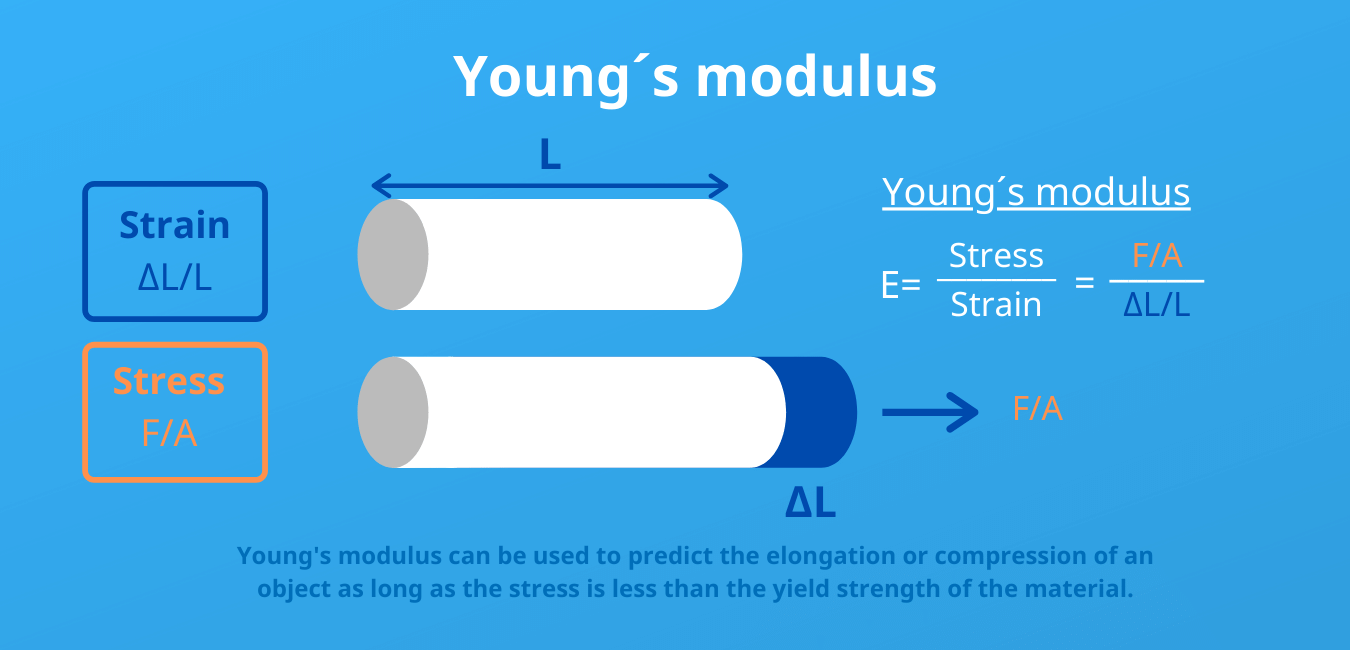
Numerical constant, named for the 18th-century English physician and physicist Thomas Young, that describes the elastic properties of a solid undergoing tension or compression in only one direction, as in the case of a metal rod that after being stretched or compressed lengthwise returns to its original length. Young’s modulus is a measure of the ability of a material to withstand changes in length when under lengthwise tension or compression.
Example: For a linear and isotropic elastic material, the YOUNG MODULUS has the same value for a traction as for a compression.